
HRIS
Often emphasizes employee information and core HR administration.
HRMS, HRIS and HCM are often used inconsistently. Treat them as useful signals about scope—not rigid product categories—and compare the real workflows, controls and implementation model behind each label.
Often emphasizes employee information and core HR administration.
Often combines the HR record with operational workforce workflows.
Often emphasizes broader talent, planning and enterprise people strategy.
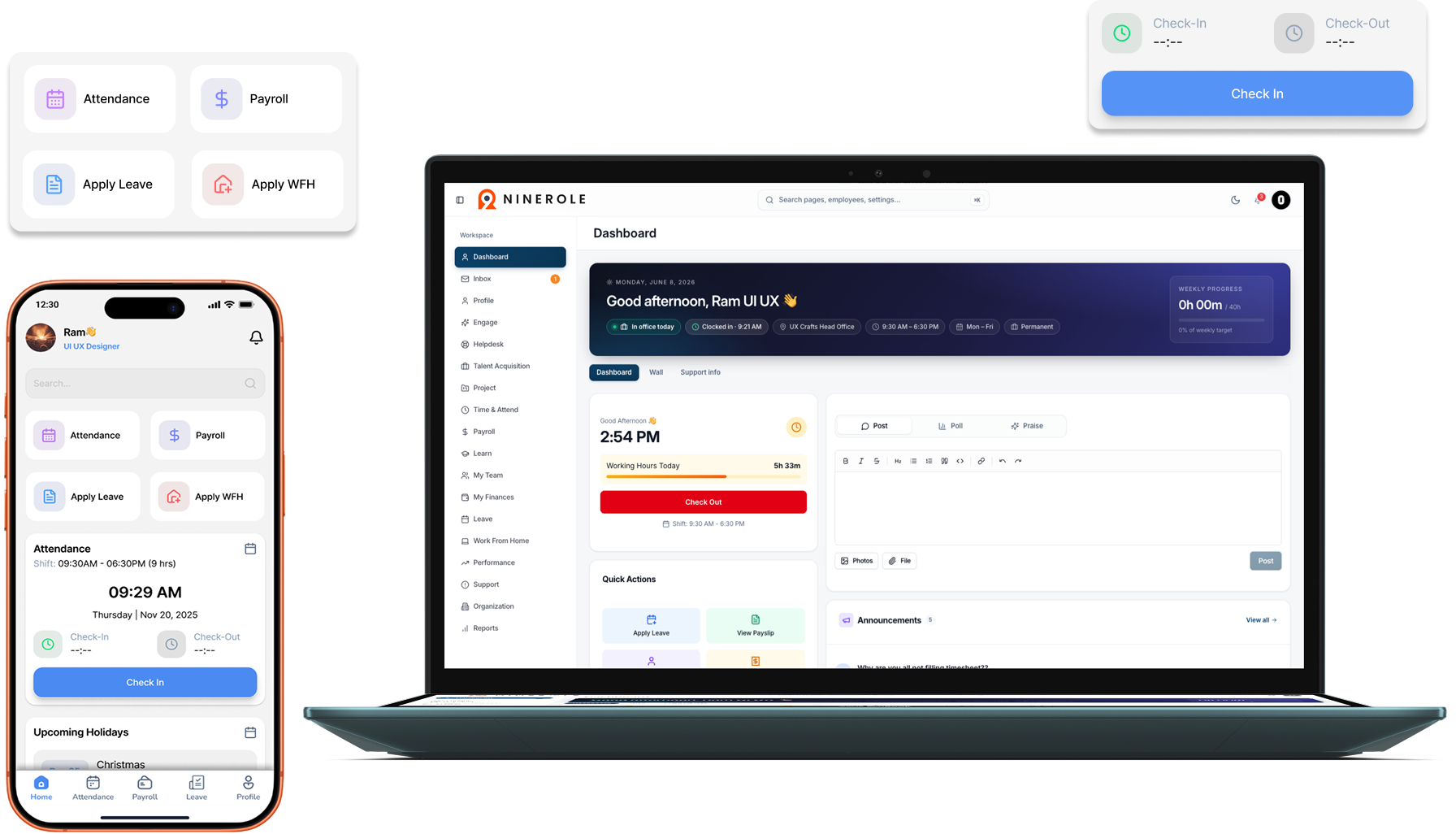
NineRole product context
A connected platform can span records, payroll, time, talent and employee service regardless of which market label is used.
01
Human Resource Information System commonly refers to the employee information foundation: profiles, organization structures, documents, lifecycle changes and reporting. Many modern HRIS products extend well beyond that definition, so the name alone does not prove a boundary.
02
Human Resource Management System commonly describes a broader operational suite that connects the HR information foundation to attendance, leave, payroll, hiring, performance and employee self-service. The shared record and workflow connections are more important than the label.
03
Human Capital Management often appears in enterprise products and strategic conversations around workforce planning, talent, compensation, development and analytics. It can include the same core modules as an HRMS, with different positioning or depth.
04
Vendors choose labels for history, market positioning and search demand. One product called HRIS may cover payroll; another called HCM may rely on an external payroll system. Build the evaluation around required work rather than assuming scope from the acronym.
05
List the workforce events your organization must handle, then ask each product to complete the same scenarios. Score the full workflow, including exceptions, permissions, reports, implementation responsibilities and total cost.
Decision framework
Vendors use these labels differently. The table describes common usage, but procurement should be based on demonstrated workflows rather than the acronym on a proposal.
| Term | Common scope | Useful when | Procurement caution |
|---|---|---|---|
| HRIS | Employee records and core administrative HR processes. | The immediate need is a dependable system of record and core workflow automation. | Modern HRIS products may include payroll, attendance and talent, so the label alone does not define scope. |
| HRMS | Core HR plus connected time, payroll, service and talent workflows. | The organization needs one employee record across recurring HR operations. | Breadth is not proof of depth; test exceptions, approvals, auditability and integrations. |
| HCM | A broad workforce-management approach spanning transactional and strategic people processes. | Enterprise workforce planning, talent and employee experience are central to the programme. | HCM may describe a strategy, a suite or both. Confirm the included applications and data model. |
SAP and Oracle both acknowledge that the terms overlap. NineRole therefore recommends comparing scope, data flow and operating controls instead of treating a label as a product category guarantee.
Verification trail
We prefer primary government publications and official vendor documentation. Links are provided so buyers can verify time-sensitive requirements and product claims directly.
Read our editorial standardsSAP
Definition, common HRMS scope and the relationship between HRMS, HRIS and HCM.
SAP
Definition of HRIS and an updated explanation of how HRIS, HRMS and HCM terminology overlaps.
Oracle
A second vendor perspective on the practical differences and overlap between HRIS, HRMS and HCM.
Clear answers to common evaluation, implementation and operating questions.
Not inherently. A broader suite is useful only when its workflows match the organization’s needs and can be implemented well. A focused HRIS may be the better fit for some teams.
The HCM label is common in enterprise software, but product scope varies. Evaluate capabilities, operating complexity and implementation requirements rather than company-size branding alone.
Yes. The terms overlap, and vendors may use more than one. The underlying modules, workflows and controls are what matter.
Continue evaluating